
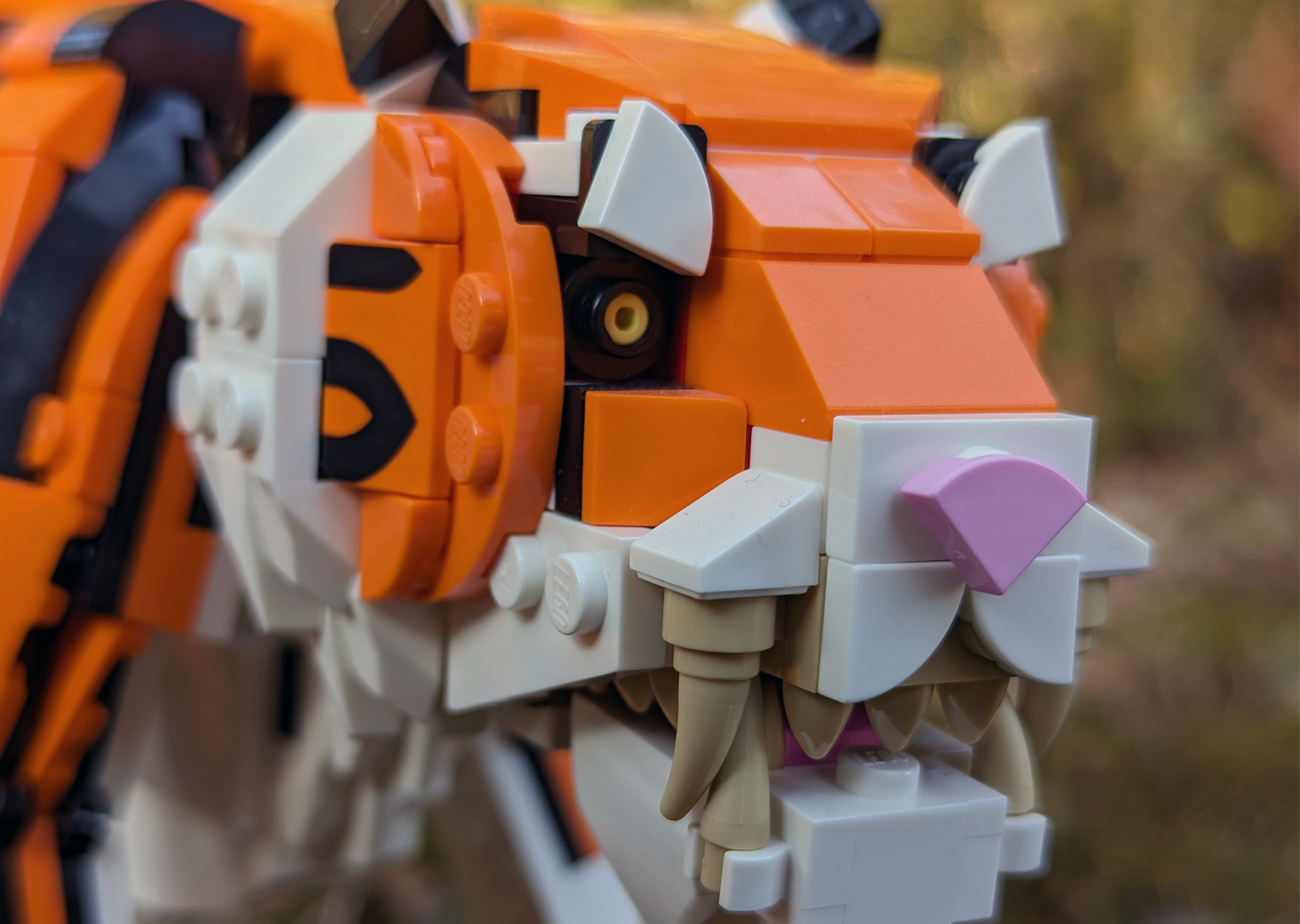
I love tigers. They have always been my favorite animal. I was thrilled when the LEGO® Group released the Majestic Tiger set in January ’22. So thrilled in fact, that I have acquired three of them in the months since. I bought box number three quite recently. Partly, inspiration arose from writing the Guide to the LEGO® Wild Cats that I published last year. However, I also read a fascinating article highlighting a natural colour variant of real tigers that was previously unknown to me. Having already built two other colourations, I decided my collection was incomplete and I should build all the different variations. Which leads me to today’s topic: natural colour variation in tigers demonstrated using LEGO® bricks.

Majestic Tiger
- SET #: 31129
- THEME: Creator 3-in-1
- COST: $64.99 CAD
- BRICK COUNT: 755
- MINIFIGURES: None
- RELEASE DATE: January 2, 2022
I bought my first copy of the Majestic Tiger for a set review. This is the most common coloration that people immediately think of when they imagine tigers. Black stripes on orange fur with a white underbelly. No matter where you find wild tigers, they look like this. However, other colour variations also exist or have existed in the wild. Subsequently, that lead to my first modification project for the Majestic Tiger.


My first tiger colour variant was the famous white tiger.
I wanted to build a white tiger. However, I did not want to take apart my orange tiger. Consequently, I acquired a second copy of the set. While the Majestic Tiger set provided most of the bricks needed, I had to replace all the orange with white. I talked about that process in an article dedicated to my white tiger build. I think white tigers are a beautiful but sad chapter in the history of men and tigers. White tigers originally occurred in the wild around Rewa, India. However, nowadays they’ve been so heavily inbred in captivity that they have no conservation value. It is because of mismanagement and human greed that white tigers no longer exist in the wild, and probably never will again.


For my third Majestic Tiger kit, I was inspired to build a pseudo-melanistic tiger. Melanism is well documented in Jaguars and Leopards. While rumors persist of melanistic tigers, no photographic or video evidence existed until recently. In the past few years, several tigers exhibiting darker coloration have arisen in the Similipal Tiger Reserve in India. They are not properly melanistic like leopards and jaguars though. In the case of tigers, some form of genetic mutation leads to a broadening of the stripes. The tigers still have orange, but it almost looks like they are black with orange stripes instead of the other way around. I tried to capture this in my LEGO® build by selectively swapping out some orange sections for black.


Pseudo-melanistic and tabby tigers also exist in the wild.
My fourth Majestic Tiger variant is the Golden Tabby tiger. Until very recently, this colour variant did not exist in the wild. It was a manmade creature seen only in roadside menageries. However, one was recently documented in India. Scientists believe that the tigress results from inbreeding due to population fragmentation in the wild, the same way tabby tigers were inbred in captivity. Interestingly, this wild appearance does suggest the possibility that the tabby tiger genes were present all along in the wild. We merely noticed them initially as a result of captive inbreeding. Alternatively, the tabby tiger genes in captivity and in the wild might be unrelated mutations that produce the same effect.


I did not buy a new Majestic Tiger kit for the tabby mod, nor for the final example of colour variation in tigers that I built. I built them mostly with my own parts and Bricklink supplementation. The last variant is the so-called snow tiger. Originally, I was not going to build this one. I have only seen them in zoos and I didn’t know they ever existed in the wild. However, I recently learned there has been at least one. It was captured in the wild and exhibited in London around 1820 at the Exeter Exchange. There are many written accounts of the snow white tiger. It had stripes, but the accounts from the time say they were only visible in certain lighting, unlike the more common white tiger. I built mine with light blueish grey stripes, similar to the one I saw in a zoo.
I only know of one “snow tiger” existing in the wild back in the 1800s.


Tigers are awesome. I have spent hours watching them in zoos. They have always been my favourite animal, hence why I built all the colour variation in tigers known to exist in nature. Sadly, I have yet to see a tiger in the wild. However, traveling to a tiger country remains on my bucket list. For now, I will have to continue appreciating them from afar. Have you built any of the tiger colour variants? Or perhaps you’ve built a colour variant of the different LEGO® animal? Let me know in the comments or reach out on social media.
Until next time,
-Tom

Want to support True North Bricks?
If you like the content at True North Bricks, please follow on Instagram, Facebook, LinkedIn, YouTube, or TikTok for regular content. Additionally, you can support True North Bricks by making your LEGO® (and other) purchases using the links in the margin to your right. As an affiliate of those retailers, we earn from qualifying purchases. These earnings come at no extra cost to you but help to keep the content at True North Bricks free.
4 responses to “Colour Variation in Tigers Demonstrated Using LEGO® Bricks”
Fantastic article about tiger colour variations.
Both my wife and I love tigers.
Thank you for doing this feature as it is informative.
Cheers. Cobra
You’re welcome! I’m glad you enjoyed it 🙂
Very cool! Excellent colour modifications! Hopefully you had enough pink flowers to complete them.
I remember going to see the white tigers at the Toronto zoo a lifetime ago. Majestic is definitely the appropriate adjective for them 🐅
Thank you! No worries, I have plenty of pink flowers 😂. There was a white tiger at Parc Safari in Quebec when I was younger as well… That’s where I fell in love with them. Sadly, most high profile zoos will not take them anymore.