
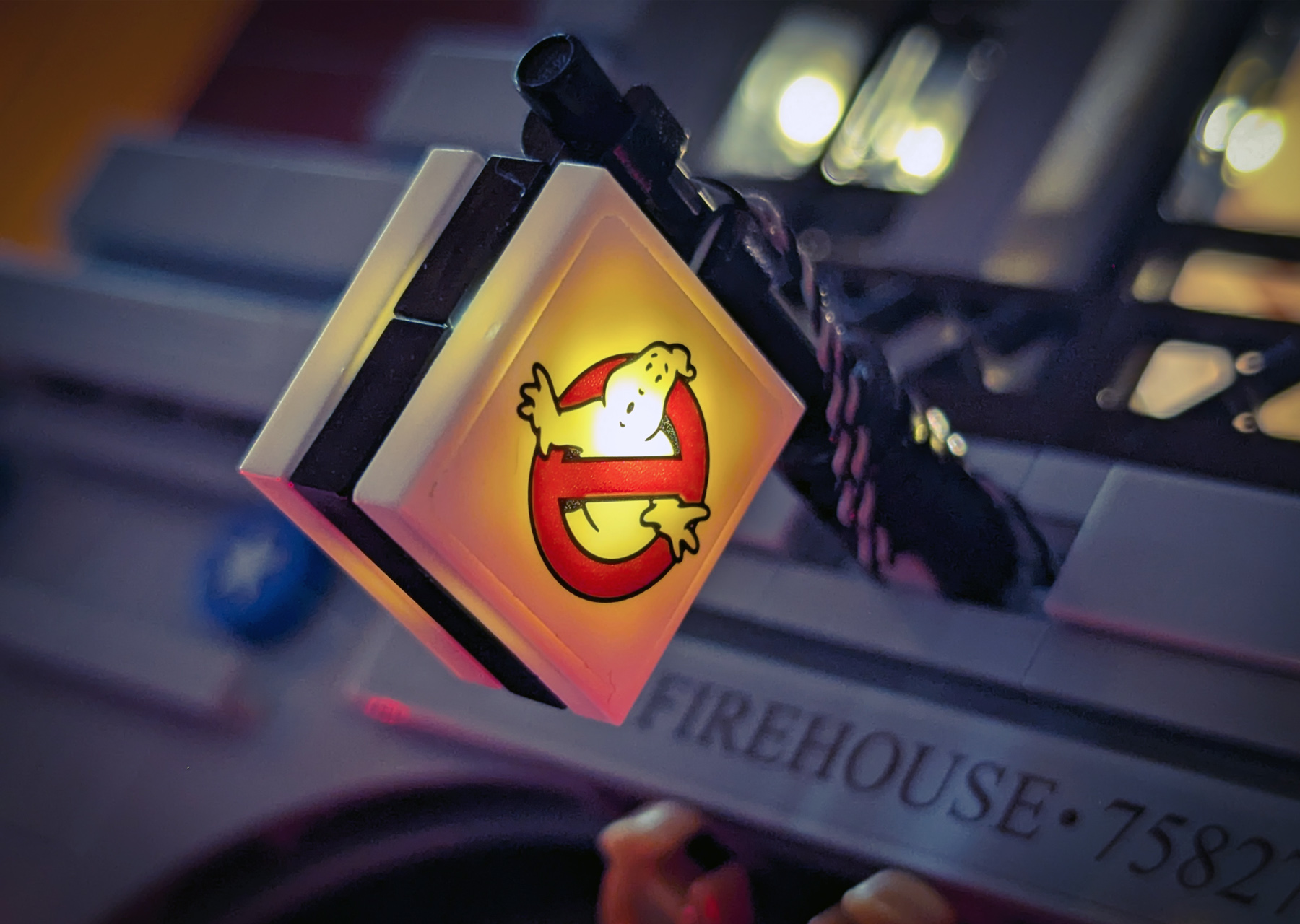
I recently took part in Brickomanie 2025, where I displayed my Viking Village MOC and also contributed to the exhibition of the 25 Biggest LEGO® Sets ever produced. For the occasion, I lent my Ghostbusters Firehouse Headquarters to the display. Since Brickomanie also featured an after-dark session, many of those sets were lit up — including mine. To make it happen, I was given a Briksmax Ghostbusters Firehouse lighting kit in exchange for installing it ahead of the show.

Now that the frantic MOC prep and the event itself are behind me, I’ve had time to reflect on the kit. This is actually the second Briksmax set I’ve reviewed. Back in 2021, Lightailing sent me a kit for the 1989 Batwing (and, embarrassingly, I spelled “Briksmax” wrong throughout that entire review). Looking back, many of the same frustrations remain — not just with Briksmax, but with other lighting brands I’ve tried, like LeLightGo. On top of that, the Firehouse revealed some new issues.

Did the finished build look good on display? Absolutely. People at Brickomanie loved it, and from a distance, the lit-up Firehouse is stunning. But up close, the flaws are hard to ignore — and in my opinion, the downsides outweigh the benefits.

Quick Review of the Briksmax Ghostbusters Firehouse Lighting Kit
| What I Liked |
|---|
| – Printed instructions – The inclusion of tweezers – The overall, lit-up look (from afar) |
| What I Liked Less |
|---|
| – Lack of batteries – Non-functional elements – Loss of modularity – Inability to test lighting as you go – Loss of brick connectivity – Visible wires – Poor adhesion of light plates |

The Pros
First off, I appreciate that Briksmax includes printed instructions. This is one area where they outshine competitors like LeLightGo, which only provides digital instructions. Call me old-fashioned, but I find flipping real pages far more practical — especially when I need to jump back a few steps.

Second, tweezers. Briksmax included them this time, and oh my God, what a difference they made. Removing adhesive covers and tucking wires into tight spots was far easier. I had a similar experience with Lumibricks’ Hunting Cabin, and I’m glad Briksmax adopted that practice too.

Finally, I can’t deny that the Ghostbusters Firehouse looks impressive lit up on a shelf. From a bit of distance, the effect is striking — exactly the kind of “wow” factor you’d want in a big display model.

The Cons
Missing Batteries
The first letdown: no batteries included. For the AA pack, that’s no big deal. But my kit also came with a remote that requires CR2025 coin cells. I don’t own anything else that uses those, so I couldn’t even test the remote without buying a whole pack of batteries I don’t need.

Non-Functional Circuit Board
Worse, one of the included circuit boards simply didn’t work. That led to hours of troubleshooting — testing each component one by one, rerouting wires, and dismantling sections I had already rebuilt. The added strain on the remaining boards eventually forced me to remove several lights just to keep the rest of the build working.

Loss of Modularity
The Ghostbusters Firehouse is designed with modular floors that can be stacked or separated. Once the Briksmax kit is installed, that feature is gone. You can still open the side wall, but the joy of being able to lift away entire levels disappears — and that makes troubleshooting even more painful.

Can’t Test as You Go
The kit’s design makes you install the battery pack last. That means you don’t know whether your wiring works until the very end. Sure, I could (and probably should) have tested each piece beforehand, but if something breaks during installation, you won’t catch it until everything is sealed up again. It would make far more sense to start with the power source and test as you build.

Wire and Brick Issues
Like every LEGO® lighting kit I’ve tried, this one weakens the clutch power of your bricks. Every wire wedged between bricks creates a tiny gap, and those gaps stack up. In places where two or three wires run together, sections of the build actually bow. Over time, that can warp the plastic.

On top of that, wires are everywhere. Some hide reasonably well in the Firehouse’s design, but others are impossible to disguise — like in the traffic light. Open the model, and the illusion shatters.

Poor Adhesion
The adhesive light plates were another frustration. They’re attached to off-brand plates, which are then stuck to LEGO® anti-stud surfaces. There just isn’t enough grip. Every time I opened the Firehouse, lights dangled by their wires — which was embarrassing when people at the convention wanted a closer look.

Final Thoughts
At this point, I’ve tried lighting kits from several different brands, and I’ve reached a conclusion: lighting up official LEGO® sets just isn’t worth it. They look fantastic from across the room, but up close the flaws are obvious, and the build suffers — loose bricks, bowed walls, visible wires, dangling plates, and endless troubleshooting.

That said, I’m not against lighting altogether. The components across brands are usually compatible, and when you design a MOC with lighting in mind from the start, it makes a world of difference. You can leave space for wires, plan for hidden battery packs, and build lighting seamlessly into the model. That’s how I plan to reuse the Briksmax Ghostbusters Firehouse kit: not for lighting up the Firehouse itself, but in a future MOC where I can control the design.

What do you think about lighting LEGO® sets? Love them, hate them, or somewhere in between? Let me know in the comments or reach out on social media.
Until next time,
-Tom

Want to support True North Bricks?
If you like the content at True North Bricks, please follow on Instagram, Facebook, LinkedIn, YouTube, or TikTok for regular content. Additionally, you can support True North Bricks by making your LEGO® (and other) purchases using the links in the margin to your right. As an affiliate of those retailers, we earn from qualifying purchases. These earnings come at no extra cost to you but help to keep the content at True North Bricks free.